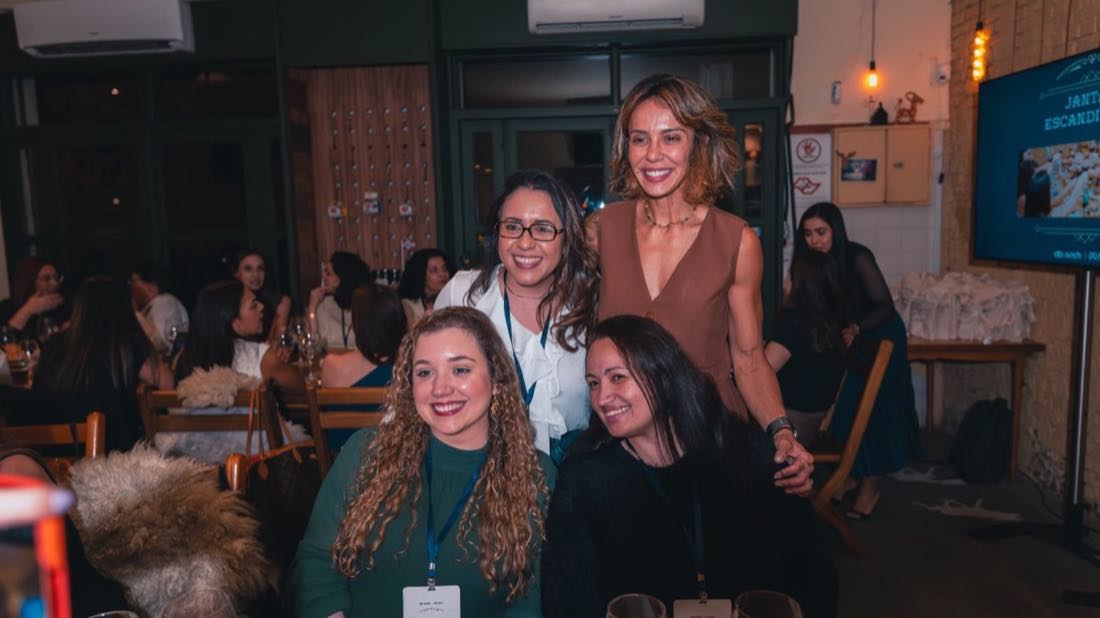
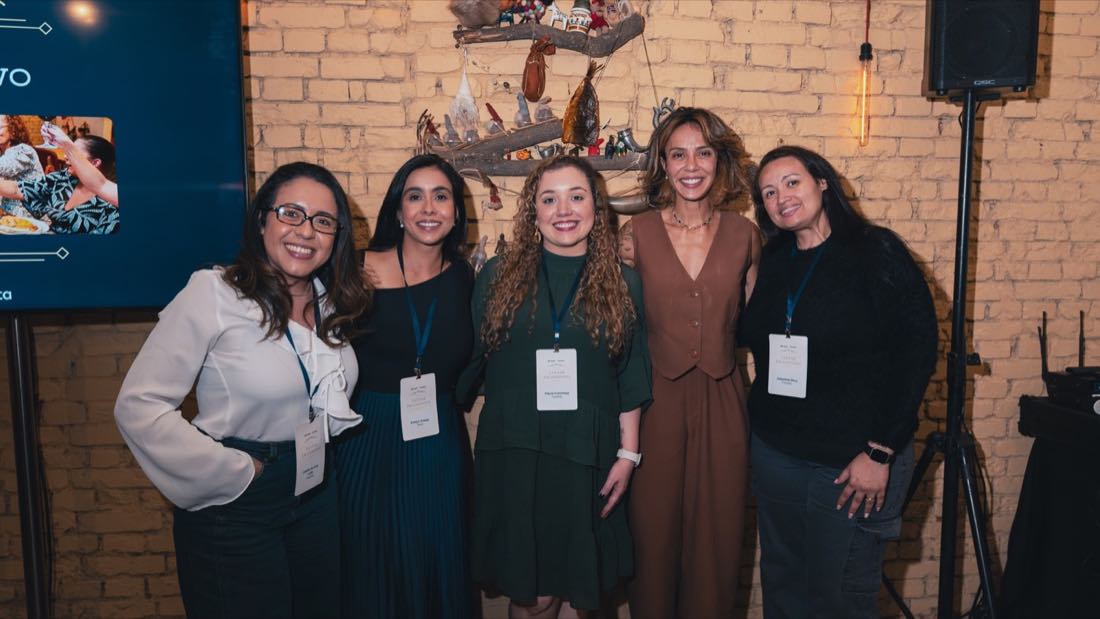
On July 18, I attended the Scandinavian Dinner hosted by Sinch, alongside women executives working at major companies in Brazil.
It was an evening of meaningful encounters, conversations, and reflection. I was delighted to share it with remarkable women, including Jaqueline Silva and Flávia Fontinhas from Familhão, members of the Sinch team, including Evelyn Araújo, and many other inspiring professionals.
A talk by Amanda Graciano invited us to recognize our strength, our value, and the importance of women in building the future.
I left with one certainty: we need to speak more about women in technology. Not only about the challenges we face, but also about everything we have built and continue to build.
Technology also has women’s names
The history of technology is often presented through a predominantly male narrative. Yet women have always been there, creating solutions, writing code, and turning ideas into advances that changed the world.
In the nineteenth century, Ada Lovelace understood that a machine could do more than mathematical calculations. A mathematician and computing pioneer, she became one of the most important figures in the history of programming.
Decades later, six women programmed ENIAC, one of the first general-purpose programmable electronic computers. They did this before programming languages and manuals existed. They had to understand the machine’s architecture and invent new ways to program it.
Hedy Lamarr, known worldwide as an actress, was also an inventor. With George Antheil, she created a frequency-hopping system that helped pave the way for modern wireless technologies such as Wi-Fi, Bluetooth, and GPS.
We are not newcomers to technology. We have always been here, even when history did not give our names the recognition they deserved.
The race does not begin at the same starting line
Women and men do not always travel the same professional road. Even when they do, they often carry different weights.
For a long time, the ideal professional was considered to be someone available for work twenty-four hours a day, seven days a week. That almost unlimited dedication rarely exists without a support structure.
Behind many men who were able to focus all their energy on their careers, there was, and often still is, a woman taking care of the home, children, relatives, schedules, and countless invisible responsibilities that keep everyday life running.
At the same time, many women build their careers while working a double or even triple shift. They work, study, lead teams, and deliver results, while remaining responsible for most care work and family organization.
This is not a lack of ambition, competence, or preparation. The race is simply heavier for those who must run it while carrying responsibilities that are often not even recognized as work.
The inequality also lives in the mental load: remembering appointments, coordinating schedules, anticipating needs, following children’s school lives, and making sure everything continues to function.
Women’s empowerment cannot mean teaching women to carry even more weight. It must mean distributing that weight fairly.
When our own voice learns to make us smaller
There is another, less visible barrier. It is built after years of hearing that we must be more prepared, speak more carefully, and continuously prove that we deserve to be in the room. Eventually, that external demand can begin to speak in our own voice.
Self-sabotage appears when we turn down an opportunity because we believe we do not know enough, minimize an achievement by calling it luck, apologize before presenting an idea, or remain silent even when we have something important to contribute.
It also appears as perfectionism. While some people apply for a position after meeting only part of the requirements, many women wait until they meet every requirement and then seek additional validation. Not because they lack ability, but because they have learned that mistakes cost them more.
Self-sabotage does not emerge from nowhere. It is often a response to environments that question women’s competence, interrupt our voices, take ownership of our ideas, or apply different standards to similar behavior. Recognizing these patterns does not mean blaming women. It gives us a chance to interrupt them.
Recognizing our value is also a practice
Valuing ourselves is not arrogance. It means looking honestly at our own journey and recognizing the knowledge, courage, and work that brought us here.
We need to name our achievements without making them smaller, negotiate without apologizing, receive praise without deflecting it, and take part in conversations without turning every sentence into a request for permission.
We also need to document results, build networks of trust, ask for compensation and recognition that reflect our contributions, and support other women when their work is not being seen. Individual recognition becomes stronger when it becomes collective.
We do not need to wait for someone else to recognize our value before we begin to recognize it ourselves. Organizations must also turn that recognition into opportunity, compensation, promotion, and real power.
Being invited to the party is not enough
There is a familiar saying: diversity is being invited to the party, while inclusion is being asked to dance.
In technology, we can go further. We do not want only an invitation, a chair, or symbolic representation. We want a voice, a role in decisions, and the power to help build the table itself.
True inclusion happens when women stop being merely counted and start being heard. It happens when we can propose ideas, take risks, make mistakes, learn, lead, and transform.
Presence matters, but real inclusion means having the power to influence what will be built and whom it will serve.
Representation changes what feels possible
When a woman reaches a leadership position in technology, her presence becomes more than an individual achievement. It expands what other women can imagine for themselves.
When we see a developer, data scientist, engineer, researcher, founder, or executive making strategic decisions, we begin to see that the space can also belong to us.
Representation matters, but presence alone is not enough. We need environments where women can participate in decisions, present ideas, take risks, learn, lead, and grow without having to prove every day that they deserve to be there.
A gathering of women in a space built by a woman
There was another meaningful detail that evening. The place that welcomed us also carries the strength of women’s entrepreneurship.
The dinner took place at O Escandinavo in Pinheiros, founded and led by chef Denise Guerschman. After living for almost a decade in Norway and Sweden, Denise returned to Brazil and transformed her experience into a business that brings Nordic culture into conversation with Brazilian identity.
The setting could not have been more fitting: a company bringing women together, a woman leading the reflection, women executives sharing experiences, and another woman welcoming everyone into the business she created.
To continue the conversation
The talk also offered reading recommendations for those who want to explore careers, leadership, innovation, and women’s presence in greater depth.
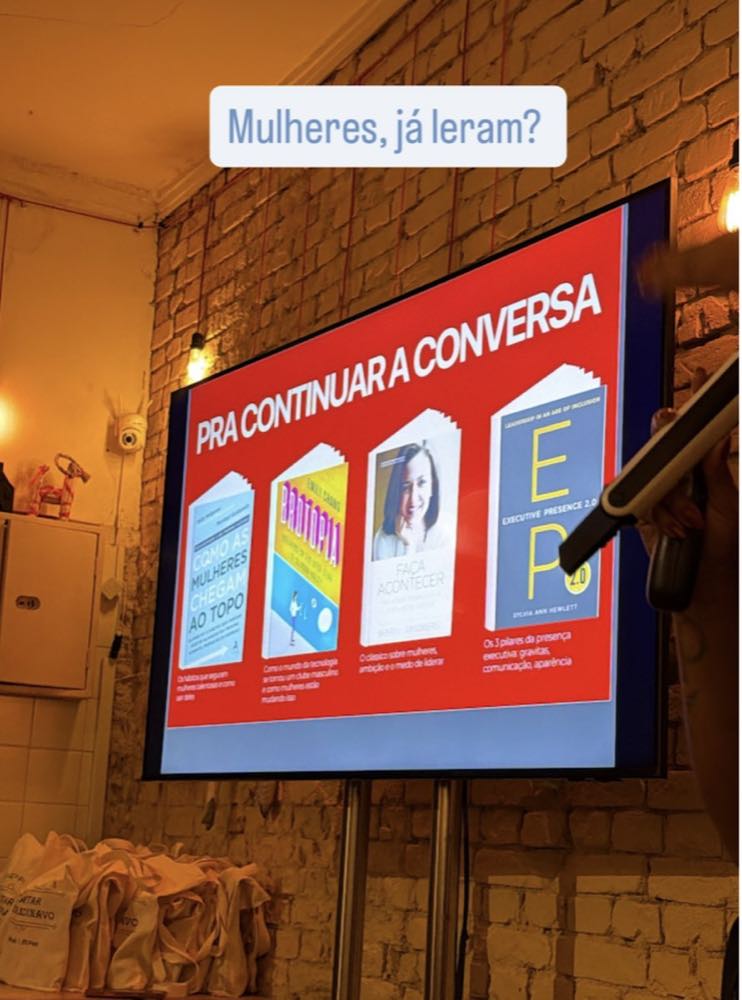
- How Women Rise, by Sally Helgesen and Marshall Goldsmith;
- Brotopia, by Emily Chang;
- Lean In, by Sheryl Sandberg;
- Executive Presence 2.0, by Sylvia Ann Hewlett.
The future of technology needs us
Technology is not only code, machines, or artificial intelligence. Technology is a human construction.
It carries the choices, experiences, and perspectives of the people who create it. When women with different backgrounds contribute to this process, we develop more inclusive products, ask better questions, and find solutions that represent a more plural society.
Our presence in technology is not a concession. It is a necessity.
We are valuable. We are creative. We are strategists, innovators, and fighters. We are part of the history of technology, even when that history did not give our names the prominence they deserved.
May we honor those who came before us, celebrate those who walk beside us, and create opportunities for those who are just beginning. The future of technology will be more human, innovative, and transformative when all of us help build it.